

Planning for retirement in Australia is about more than reaching a savings target. It is about deciding how you want to spend your time, where you want to live and how you will pay for the life you have in mind. Services Australia makes the same point in its guidance for people thinking about retirement: work out how you want to live first, including where you will live, whether you will travel and how you will stay connected, then build a financial strategy around it.
This guide follows that order. It covers when you can retire, how to plan for retirement around the lifestyle you want, your retirement living options, what retirement costs, where your income may come from, and the support, health and legal matters worth sorting early. It finishes with a retirement planning checklist you can work through at your own pace.
When can you retire in Australia?
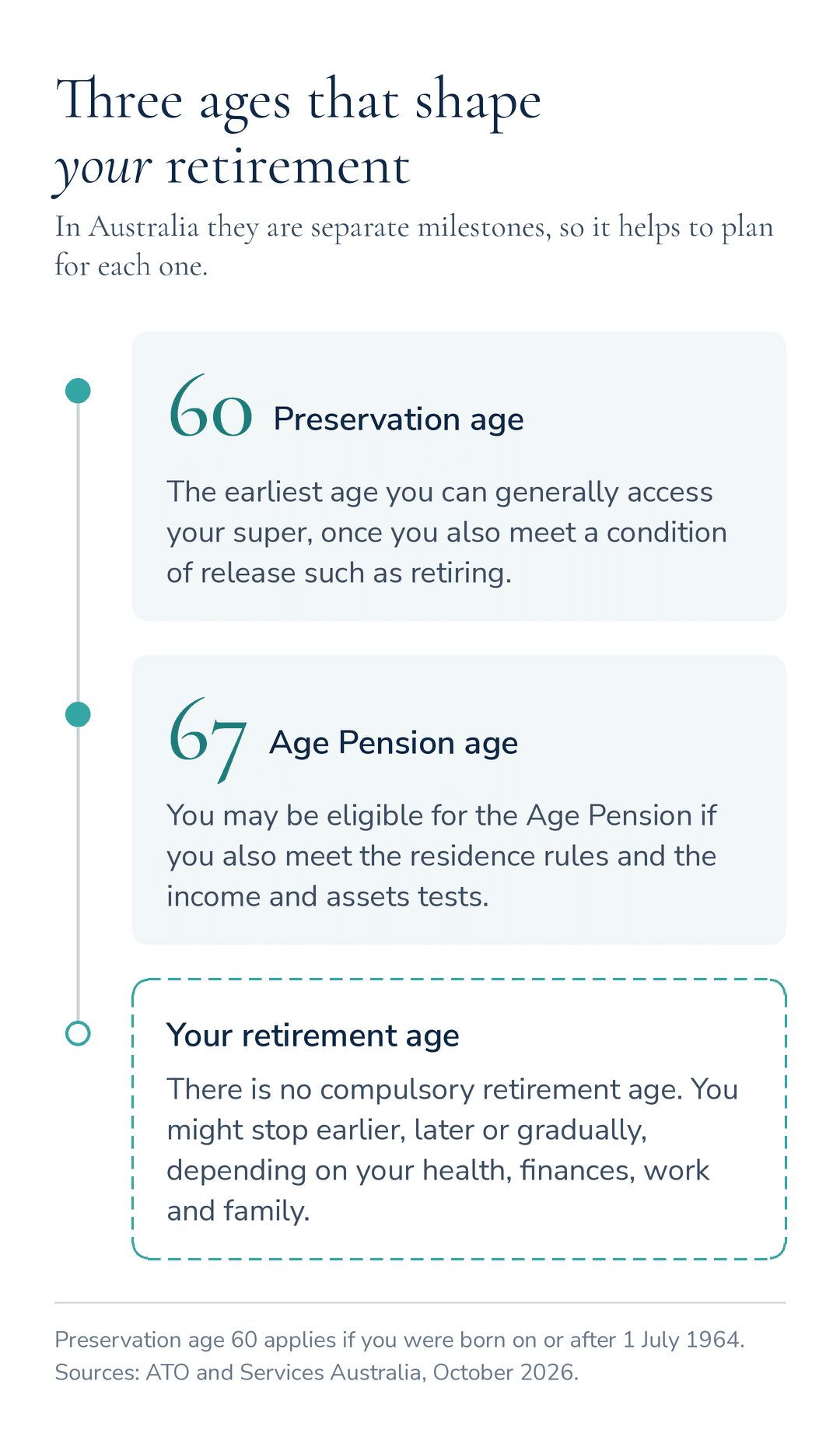
There is no compulsory retirement age in Australia. When planning for retirement, three different ages tend to shape your decisions:
- Your preservation age. This is the earliest age you can generally access your super, as long as you also meet a condition of release such as retiring. For anyone born on or after 1 July 1964, preservation age is 60. The ATO explains the rules for accessing your super when you retire.
- Age Pension age. You need to be 67 or older to get the Age Pension, and you also need to meet residence rules and the income and assets tests. Services Australia sets out who can get the Age Pension.
- The age you choose. Many people stop work earlier or later than either of these ages, depending on their health, finances, work and family.
Because these ages are separate, it helps to map out what your income could look like in each stage, for example between stopping work and reaching Age Pension age. Our guides on when you can retire in Australia and retiring at 55 go into more detail.
Moving from work to retirement
Retirement does not have to happen on a single day. Some people stop work completely, while others reduce their hours, take on consulting or seasonal work, or try a new kind of job before stepping back fully.
Once you reach preservation age, a transition to retirement income stream may let you draw some of your super while you keep working. The rules and tax treatment are specific, so check how it would work with your super fund or the ATO before deciding whether it suits you.
It is also worth talking through timing with your partner, who may want to retire at a different time. And plan for the personal side of leaving work. For many people, work provides routine, purpose and social contact, so it helps to think about what will replace those things before your last day.
How to plan for retirement: start with your lifestyle
Planning for retirement starts with an honest picture of a normal week. Holidays and big plans matter, but everyday routines will shape most of your time. Think about how you would like to spend a typical Tuesday, who you will see and what will keep you busy and healthy.
Travel and time away
If travel is part of your plans, consider where you want to go, how often and for how long, and what it is likely to cost. Your home matters here too. A low-maintenance home that is easy to lock up and leave makes longer trips simpler, while a large garden or pool needs looking after while you are away.
Getting around
Some retirees drive less and decide whether to keep a car. Weigh up the running costs against public transport and community transport options where you live, and think about how you will get to appointments, shops and family if you stop driving in future.
Staying social, active and purposeful
Clubs, volunteering, sport, learning something new and time with grandchildren can all give retirement shape. Living close to people with similar interests also makes it easier to stay connected. For ideas, see our list of the best retirement activities and our look at the benefits of living in a retirement community. You can also read how our homeowners stay active and save money in a Hometown community.

Where to live in retirement
Where you live affects almost every other part of your retirement plan: your costs, your social life, your health and how easily family can visit. Services Australia suggests your decision depends on things like whether you own your home, the cost of major renovations or maintenance, your health, and your connection to family and the community.
Questions to ask about your current home
- Does it still suit the way you live, or are there rooms you rarely use?
- How much time and money does maintenance take, and is that likely to grow?
- Will it work for you if your mobility or health changes, for example with stairs or a steep driveway?
- Are you close to the people, services and activities that matter to you?
Retirement living options in Australia
There is no single right answer, and many people weigh up several retirement living options before deciding. The main ones are:
Staying in your current home. Ageing in place keeps you in familiar surroundings and close to established connections. It can mean modifying the home over time, and government-funded in-home support may be available if you need it later (see the health and future care section below).
Moving to a smaller or more manageable home. A home that is easier to look after can free up time and, in some cases, money. It also involves selling, buying and moving costs. Our guide to downsizing in Australia covers that decision and process in detail.
Land lease communities. In a land lease community, you own your home and lease the land it sits on. Communities are designed for over 50s and usually include shared amenities such as a clubhouse, pool and gym, with an on-site team and a social calendar. With a Hometown Australia home, there is no stamp duty on the purchase, no exit fees and no council rates, and you keep 100% of any capital gain when you sell. You pay an ongoing site fee, and eligible pensioners may be able to receive Rent Assistance towards it. Always check the site agreement and current fees for the specific home and community you are considering.
Retirement villages. Retirement villages offer a range of ownership and occupancy arrangements, and fees vary between villages. Before committing, compare entry costs, ongoing fees, departure or deferred management fees and how any capital gain is shared. For a side-by-side look at the two community models, see how land lease communities compare to retirement villages.
Renting. Renting offers flexibility and no large upfront purchase, but rent is an ongoing cost that can rise over time. As the next section shows, housing costs make a big difference to how much retirement costs.
Moving closer to family. Being near children and grandchildren can make everyday support and time together easier. It works best when you still have your own space, routines and friendships.
Option | What you own | Upfront costs | Ongoing costs | Exit fees | Maintenance | Community and amenities |
|---|---|---|---|---|---|---|
Staying in your home | Your home and the land | None to stay, though you may need to modify the home over time | Council rates, insurance, utilities, repairs | None | All yours, inside and out | Your existing neighbourhood and connections |
Smaller home | Your new home and the land, or a strata share | Purchase price, stamp duty, plus selling and moving costs | Council rates, insurance, utilities and any strata fees | None, though selling costs apply when you sell | Usually less than a larger home | Depends on where you move |
Land lease community (Hometown Australia) | Your home; you lease the land it sits on | Home purchase price, with no stamp duty on the home | Site fee, utilities and home insurance, with no council rates | No exit fees, and you keep 100% of any capital gain | Your home; the on-site team looks after shared areas | Shared amenities such as a clubhouse, pool and gym, plus a social calendar |
Retirement village | Varies by contract | Varies by contract | Varies by contract | Varies by contract, and may include deferred management fees | Varies by contract | Shared facilities and activities, which vary by village |
Renting | Nothing; you lease the home | Bond and moving costs | Rent, which can increase, plus utilities and contents insurance | None | Mostly the landlord's responsibility | Depends on where you rent |
Future-proofing your next home
Whichever option you choose, look for features that will keep working for you as your needs change: step-free access, a manageable layout on one level, an easy-to-use bathroom, a low-maintenance garden, and good access to healthcare, shops and transport.

Choosing where to retire
Some people stay close to their current suburb. Others use retirement as the time for a sea change or tree change. If you are considering a move, spend time in the area at an ordinary pace rather than as a holidaymaker, and check the essentials, such as how far you will be from a GP, a hospital, shops and family. Our guide to the best places to retire in Australia is a good starting point.
The cost of living in retirement
What retirement costs depends on your lifestyle, your health, where you live and, above all, your housing. A widely used benchmark is the ASFA Retirement Standard, published by the Association of Superannuation Funds of Australia. According to the June quarter 2026 Retirement Standard, a comfortable retirement for a homeowner couple aged 65 to 84 costs $78,998 a year, and for a single homeowner it costs $1,076 a week, or around $56,000 a year. A modest retirement for a single homeowner costs $700 a week.
These budgets assume you own your home outright, which keeps the cost of living in retirement lower. For retirees who rent privately, ASFA's modest budget rises to $69,376 a year for a couple and $51,418 for a single person. In other words, a single person renting needs almost as much for a modest lifestyle as a single homeowner needs for a comfortable one.
That is why housing is one of the biggest decisions in any retirement budget. When you compare options, look at the ongoing costs side by side:
Ongoing cost | Owning your home outright | Renting | Land lease |
|---|---|---|---|
Main housing cost | No rent or site fee | Rent, which can increase over time | |
Council rates | Yes | No | No |
Insurance | Building and contents insurance | Contents insurance | Home insurance |
Utilities | Yes | Yes | Yes |
Maintenance and repairs | Yes, and can be significant in an older home | Mostly the landlord's responsibility | Your home; the on-site team looks after shared areas |
Rent Assistance | Not applicable | May be available to eligible pensioners | May be available to eligible pensioners towards the site fee |
Building your retirement budget
A retirement budget starts with what you spend today. Review a few months of real spending, then separate essentials such as food, utilities, health and transport from extras such as dining out, travel and gifts. Allow for one-off costs that are easy to forget, like replacing a car, home repairs or a big trip, and build in a buffer for rising prices.
Moneysmart's free budget planner can help you map your spending, and its retirement planner estimates the income you may get from super and the Age Pension. Use benchmarks like ASFA's as a reference point rather than a personal target. For more on lump sums, see our article on whether $1 million is enough to retire on in Australia.
Where your retirement income may come from
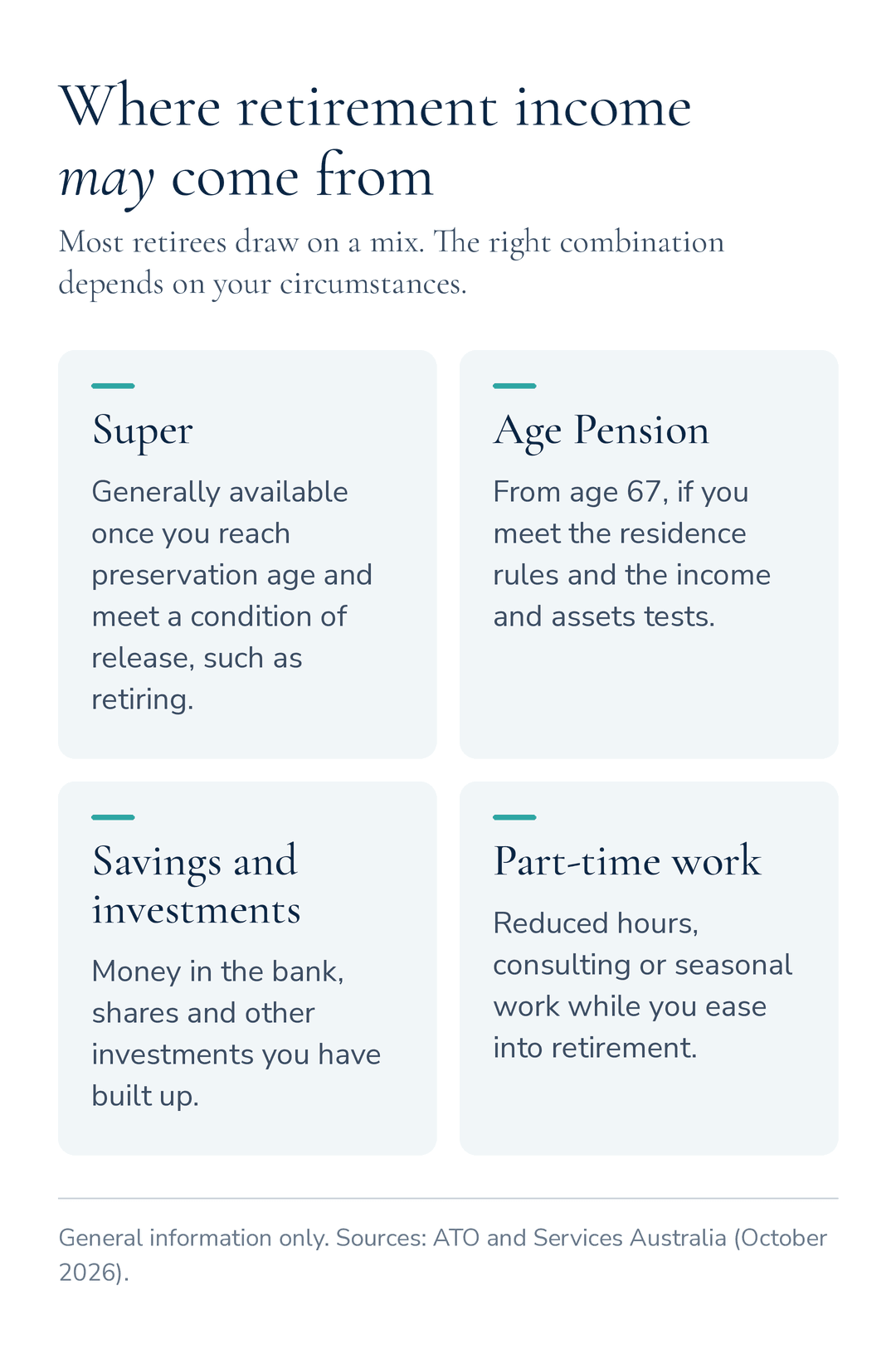
Most retirees draw on a mix of income sources. The right combination depends on your circumstances, so treat the points below as general information to help you ask the right questions.
Super
Once you meet a condition of release, you can generally take your super as a regular income stream, as a lump sum or as a combination of both. Check how many super accounts you have, what you are paying in fees and whether your details are up to date. Our article on how much super you need to retire at 55 looks at super balances in more detail.
The Age Pension
The Age Pension is available from age 67 to people who meet residence rules and the income and assets tests. The home you live in is not counted under the assets test, but most other assets and income are. ASFA estimates that the full Age Pension covers around 60 per cent of a comfortable retirement budget for a couple. Read more about how the Age Pension income test works.
Other income
Savings, investments and part-time work can all add to your retirement income. If you plan to sell your home as part of your plans, the downsizer super contribution may be relevant. It is explained in our guide to downsizing in Australia.
Concessions and support for retirees
Retirees can be eligible for a range of concessions that reduce everyday costs. Eligibility rules apply, so check your situation with the relevant agency.
Card or payment | Who it is for | Main benefits | Where to apply |
|---|---|---|---|
Older residents who meet their state or territory's age and work-hour rules | Discounts on transport and from participating businesses | Your state or territory's Seniors Card program | |
People of Age Pension age who don't get the Age Pension and meet the income test | Cheaper prescription medicines and other concessions | Services Australia | |
Pensioner Concession Card | People who receive the Age Pension | Cheaper medicines and other concessions | Generally issued with the Age Pension through Services Australia |
Age Pension recipients who pay rent, or fees in an over 55s village or lifestyle park | Help towards rent or site fees | Services Australia |
Health and future care
Staying active, keeping up regular health checks and planning for health costs, such as dental care, hearing and private health insurance, all belong in a retirement plan.
It is also worth understanding how in-home support works before you need it. The Support at Home program replaced the Home Care Packages Program on 1 November 2025 and helps eligible older people live independently at home for longer, with services such as personal care, cleaning and nursing. Access starts with an assessment through My Aged Care, and you may be asked to contribute to the cost depending on your circumstances. Because land lease homeowners live in their own home, in-home support can generally be delivered there, subject to assessment.
Legal and estate planning
A few legal documents protect you and make things easier for your family if your circumstances change:
- A current will that reflects your wishes.
- An enduring power of attorney, so someone you trust can make financial and legal decisions if you can't. Moneysmart explains how an enduring power of attorney works.
- An advance care directive or medical decision-maker appointment, which records your health care wishes.
- Up-to-date beneficiary nominations for your super.
Forms and rules for powers of attorney and advance care directives vary by state and territory, so a lawyer or your state's public trustee can help you get them right.
Free help and advice
You don't have to do your planning for retirement alone. Services Australia's free Financial Information Service runs seminars and appointments for people nearing retirement and retirees, and you can call it on 132 300. Moneysmart has free calculators and guides. If your situation is complex, a licensed financial adviser can give advice tailored to you, and Moneysmart explains how to choose a financial adviser.
Common retirement planning mistakes to avoid
- Planning only the money. A plan that ignores lifestyle, health and housing can leave you financially ready but unsure what to do with your time.
- Underestimating how long retirement lasts. Retirement can easily run for two decades or more, so plan for your needs at 85 as well as at 65.
- Forgetting one-off costs. Car replacement, home repairs and helping family can put pressure on a budget built only on weekly spending.
- Leaving housing decisions until a crisis. Choosing where to live while you are healthy gives you more choice and more time to settle in.
- Comparing homes on purchase price alone. Ongoing fees, exit fees and how capital gains are treated can matter just as much.
- Not checking entitlements. Many retirees are eligible for concessions they never claim.
- Letting legal documents lapse. Wills, powers of attorney and super nominations need reviewing after major life changes.
Retirement planning checklist
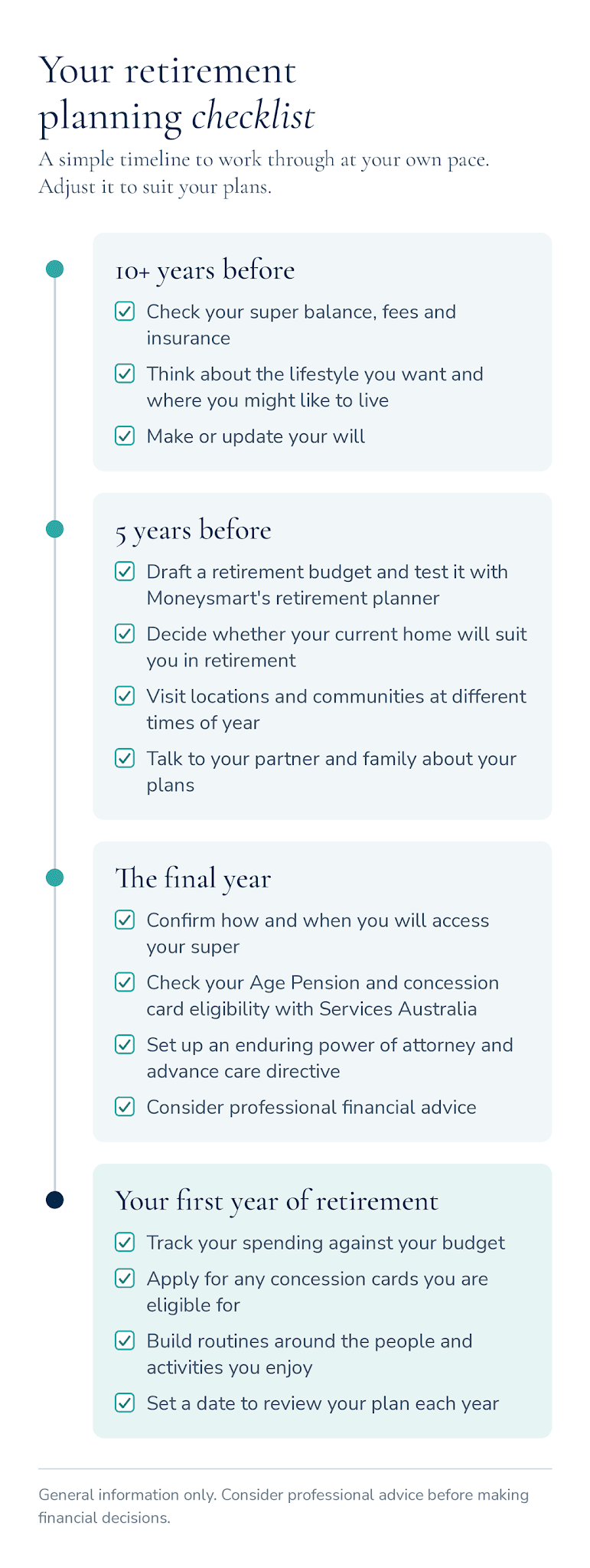
Use this retirement planning checklist as a guide, and adjust the timing to suit your plans.
10 or more years before retirement
- Check your super balance, fees and insurance, and consolidate accounts if it suits you.
- Start thinking about the lifestyle you want and where you might like to live.
- Make or update your will.
Five years before retirement
- Draft a retirement budget and test it with Moneysmart's retirement planner.
- Decide whether your current home will suit you in retirement. If you are thinking about moving to a smaller home, read our guide to downsizing.
- Visit locations and communities you are considering, at different times of year.
- Talk to your partner and family about your plans.
The final year before retirement
- Confirm how and when you will access your super.
- Check your likely Age Pension and concession card eligibility with Services Australia.
- Set up an enduring power of attorney and advance care directive if you haven't already.
- Consider getting professional financial advice.
Your first year of retirement
- Track your spending against your budget and adjust it.
- Apply for any concession cards you are eligible for.
- Build routines around the activities and people that matter to you.
- Set a date to review your plan each year, and after any major change.
Retirement planning in Australia: FAQs
Planning for retirement is easier when you know where you want to live. If a land lease community sounds like a good fit, browse Hometown homes for sale or explore our communities across NSW, QLD, VIC and SA.
Important information: This article provides general information only and does not take into account your personal objectives, financial situation or needs. It is not financial, tax or legal advice. Figures and rules are current as at October 2026 and may change, so check the latest details with Services Australia, the ATO and the other sources linked above, and consider seeking advice from a licensed financial adviser before making decisions.